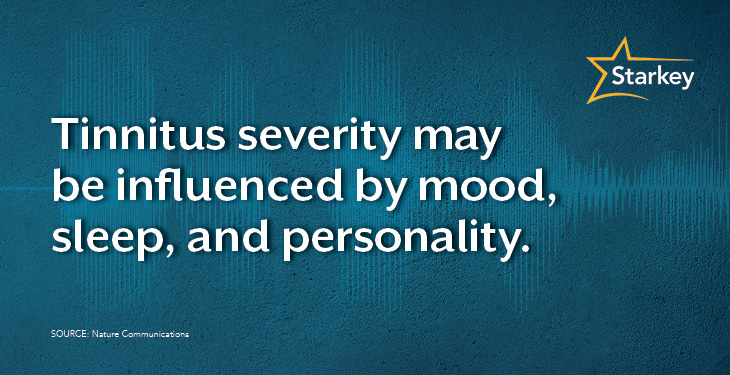
Did you know that factors beyond hearing loss can affect how severely we experience tinnitus? For years, researchers and clinicians have examined the effects of diet and stress on tinnitus intensity. Now, thanks to a recent study, researchers have identified which factors play the biggest role in tinnitus severity.
But before we go deeper into today’s hearing fact and the research behind it, let’s first recognize Tinnitus Awareness Week, currently in progress. It’s an important global initiative created to call attention to tinnitus, its challenges, and advancements in research.
Being cognizant of tinnitus and factors that can shape the severity of the condition (which today’s hearing fact touches on) is especially necessary now, given that the prevalence of tinnitus increases as we age.
So, let’s start by refreshing ourselves on what tinnitus is: Tinnitus is a hearing health condition that impacts 10 to 25% of U.S. adults, and is characterized by the continuous sensation of ringing or other noise (buzzing, roaring, humming, etc.) in the ears when no other noise is present.
This aggravating condition is commonly caused by age-related hearing loss, noise exposure, medications, ear wax, ear infection, and other ailments.
While there currently is no cure for tinnitus, effective treatment is available through hearing technology—which we’ll dig into shortly.
But first, let’s learn more about today’s hearing fact, the study behind it, and the good news about an effective solution that can help us alleviate tinnitus symptoms—hearing aids.
Researchers use predictive model to study tinnitus impact
Researchers from Quebec’s McGill University and Paris’ Institute Pasteur collaborated on a study aimed at understanding how tinnitus affects people on an individual level.
They began by developing a predictive model to help “forecast whose (tinnitus) symptoms are likely to worsen, offering a chance to intervene earlier,” according to Etienne Vachon-Presseau, senior author of the study.
The researchers tested the model on approximately 200,000 people, examining data surrounding their health and behavior.
The results
The key warning drivers for severe tinnitus were identified as:
- Recurring fatigue
- Low mood
- Poor sleep
- Excessive neuroticism (a personality trait characterized by the tendency to respond with negative emotions such as worry, anxiety, and irritability)
Additionally, even though hearing loss was discovered to be the strongest indicator for developing severe tinnitus, the actual severity was more closely linked to the above psychological and behavioral variables.
The scientists concluded that “tinnitus severity is influenced by psychosocial factors, underscoring the significance of interventions targeting these factors. It is also influenced by hearing health, suggesting that deeper hearing loss will trigger more intrusive tinnitus.”
Hearing technology—an effective solution for relieving tinnitus
Certainly, most people with tinnitus do have some level of hearing loss. Does that mean that wearing hearing aids can help with tinnitus? According to numerous studies, tinnitus patients have experienced positive results when wearing the devices.
In fact, here are 3 of the biggest ways wearing hearing aids can help relieve tinnitus:
1. Distract from tinnitus through new sounds
Wearing hearing aids can help us divert our attention away from tinnitus noise by introducing “new” sounds our hearing loss had been depriving us of, for some time. These can include anything from the sound of our dog’s footsteps across the kitchen floor to the hum of the furnace to birds chirping out the window.

2. Reduce stress and fatigue
Now that we know what’s involved with tinnitus, we can understand how it could impact our quality of life by causing tension, strain, and exhaustion—all of which wearing hearing aids can help relieve.
Research has shown that wearing hearing devices can significantly reduce daily listening-related fatigue for us. Moreover, because wearing hearing aids can help us improve our hearing and communication, we are more empowered to make social contact—a great stress-reliever as we gain much-needed support and distraction from overwhelm associated with tinnitus.
3. Mask tinnitus sounds
When tinnitus becomes relentlessly bothersome, Omega AI hearing aids are a huge help for providing relief through maskers.
A form of sound therapy, a masker is a continuous noise that plays through our hearing aids to further distract us from those irritating tinnitus sounds.
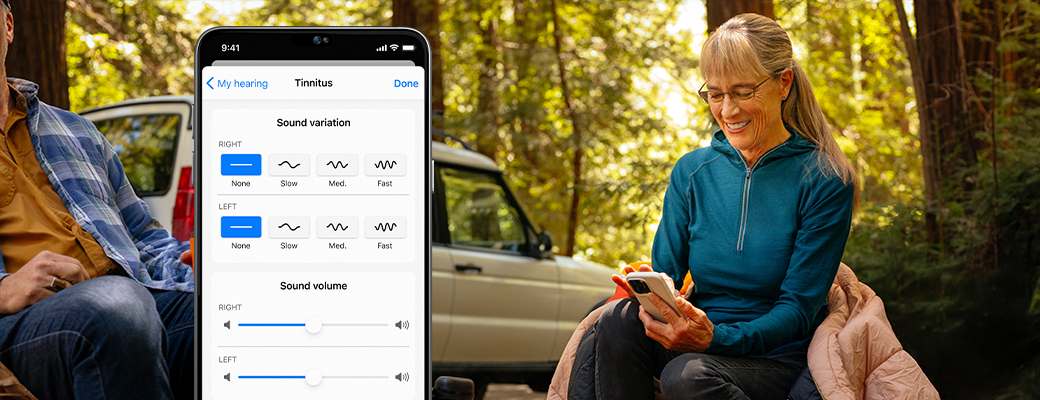
Omega AI hearing aids feature masker options we can select based on our preferences, that we can fine-tune anytime with help from our hearing care professional. Labeled “pink,” “brown,” “blue,” and “red” noises, each focuses on different frequencies of sound that can be modulated or varied and adjusted for volume using the My Starkey app. (Ocean sounds are also available to help with relaxation).
A hearing care professional can make using tinnitus maskers easier than ever. They can add and adjust the maskers, plus counsel us on the best and safest use of the technology for maximum relief from our unique tinnitus.

Tinnitus relief is within reach—see a hearing care professional
Think you may be experiencing tinnitus or know someone who is? There is no better time than right now—Tinnitus Awareness Week—to schedule an appointment with a licensed hearing care professional. They can evaluate the tinnitus and hearing loss and recommend the best treatment for individual needs.
If you don’t have one, no problem—simply type your zip code in here and you’ll see a list of providers you can connect with.